

Disclaimer: Information in this article is summarised from official SARA and STR guidelines. For the latest updates, please refer to government portals such as sara.gov.my and bantuantunai.gov.my.
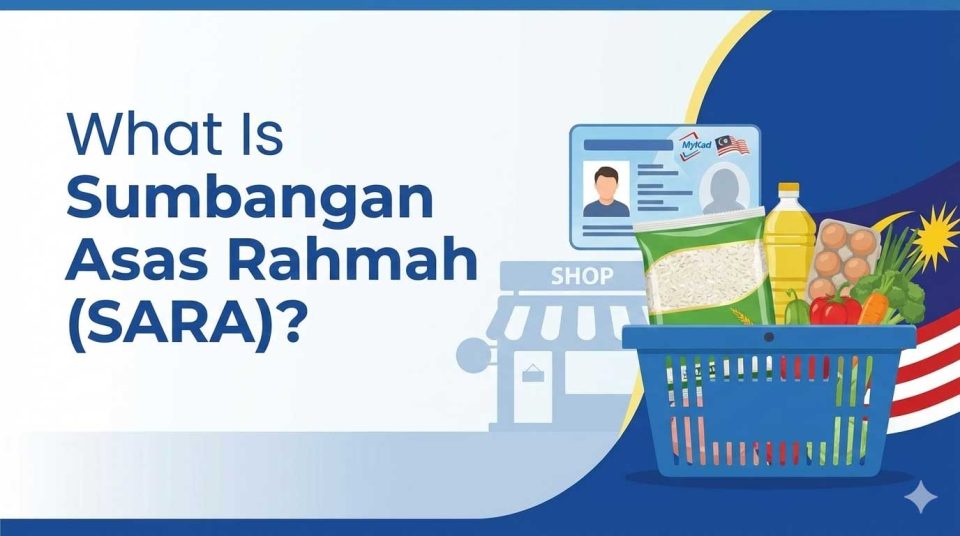
[Last updated: December 2025] As living costs keep climbing, Sumbangan Asas Rahmah (SARA) has quietly become one of the most important lifelines for low-income Malaysians – especially those already in the Sumbangan Tunai Rahmah(STR) and eKasih systems. Yet if you ask around, most people will say: “I tahu STR, tapi SARA ni apa sebenarnya? Top up? MyKasih? Berapa dapat?”
SARA 2025 is running under Belanjawan 2025, channelled cashlessly via MyKad at selected supermarkets and grocery shops. It doesn’t replace STR– it sits on top of it as an extra layer of help, specifically for households most affected by the cost of essentials like rice, eggs, oil and fresh food. View full list at eCentral for Senarai Barang MyKasih/Bantuan SARA RM100
This guide is meant to cut through the noise: what SARA really is, who gets it, how the MyKad system works, and why some people receive RM200 a month while others don’t see it at all – even though they are also B40.
SARA in a Nutshell
SARA is extra bantuan for STR recipients, paid as monthly grocery credit via MyKad, not as cash.
Under Belanjawan 2025, SARA targets two main groups:
- Households and elderly who already receive STR, and
- Those classified as “Miskin” or “Miskin Tegar” in the eKasih poverty database.
Both sit under the same umbrella: the government uses STR as the main database, and eKasih to identify who is at the very bottom of the income ladder. eKasih recipients receive the highest monthly SARA amount receive the highest monthly SARA amount, while STR-only households receive a lower but still meaningful amount.
None of this money ever touches a bank account. The funds are loaded into your MyKad and can only be spent at participating supermarkets, mini markets and grocery shops under the MyKasih network. At the cashier, you hand over your IC, they scan it, and the system deducts from your SARA balance for approved items.
SARA Key Facts(2026)
Type: Monthly food aid (top-up to STR)
Amount: ~RM50–RM200 / month
Period: Jan–Dec 2025, no rollover
Delivery: MyKad at registered shops (MyKasih)
Who qualifies: Selected STR + eKasih recipients
Official info: SARA.gov.my
How SARA Actually Works(STR, eKasih & MyKad)
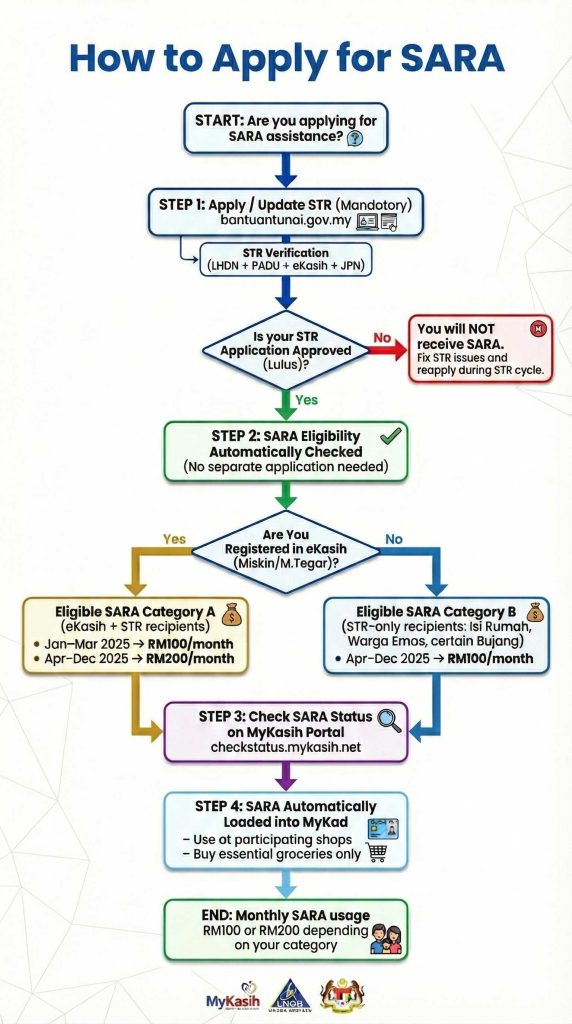
You must have your STR approved (shown as Lulus in the STR portal) before SARA can be activated. There is no separate SARA form, no extra application, and no additional portal to sign up. It is a layered system built on top of STR, powered by MyKad, and filtered by eKasih for the highest levels of support.
Once STR is approved, the government automatically checks:
- your income data (via PADU & LHDN)
- your household structure
- whether you are listed under eKasih (Miskin / Miskin Tegar)
- your STR category (Isi Rumah, Warga Emas, Bujang in certain cases)
This verification process determines which SARA tier you fall into — or whether you qualify at all.In simple terms:
STR = Gateway
eKasih = Determines your tier
SARA = Monthly benefit you actually receive
Eligibility Is Checked Automatically (No Extra Step Required)
After STR approval, SARA eligibility is processed automatically in the system.You do not need to apply again, make an appointment, or upload documents.The system simply decides:
✅ High-tier SARA (eKasih group)
✅ Standard-tier SARA (STR-only group)
❌ Not eligible (outside SARA categories)
This automation is why some Malaysians only discover they have SARA when they check MyKasih — it often appears without any notification or SMS.
Monthly Credit Is Loaded Directly Into Your MyKad
SARA is cashless. There is no bank transfer, no DuitNow, and no e-wallet credit. Instead:
- A MyKasih account is linked to your MyKad.
- Your SARA amount is credited into that account on a monthly cycle.
- You spend it by tapping or scanning your MyKad at participating shops.
The cashier selects the MyKasih / SARA payment option at checkout. The system automatically deducts approved essential items from your SARA balance.
No pin. No app. No physical card. Your IC is the payment tool.
Who Actually Gets SARA? (Eligibility Breakdown)
Although SARA is widely discussed as if “semua B40 dapat,” the programme is actually targeted and tiered. Not every STR recipient qualifies, and not every qualified person receives the same amount. The government uses two data sources — STR and eKasih — to decide who gets SARA and how much they receive.
The First Requirement: You Must Be an Approved STR Recipient
SARA does not exist without STR. To even be considered, you must fall under one of the approved STR 2025 categories:
- Isi Rumah (household recipients)
- Warga Emas Tiada Pasangan
- Certain Bujang groups, but only if they fall into the eKasih category
Anyone who is not approved under STR — including households that “think” they are B40 but never updated their STR details — will not receive SARA.
This is the starting gate. If STR = Tidak Lulus, then SARA = Tidak Layak.
The Second Filter: eKasih Determines Your Tier (High vs Standard)
Once STR is approved, the system checks whether the household is registered in eKasih as:
- Miskin
- Miskin Tegar
This status places you into the highest SARA tier.
✔ If You Are in eKasih → You Receive High-Tier SARA
This includes:
- eKasih + STR Isi Rumah
- eKasih + STR Warga Emas
- eKasih Bujang (special case)
High-tier SARA is the group that receives:
- RM100/month (Jan–Mar 2025)
- RM150–RM200/month (Apr–Dec 2025)
They are the ones who feel SARA from the very beginning of the year and receive the largest total amount.
✖ If You Are NOT in eKasih → You Receive Standard-Tier SARA Only (If Eligible)
If your STR is approved but your household is not listed in eKasih, you may still receive SARA — but at a lower tier.
This applies to:
- STR Isi Rumah (not in eKasih)
- STR Warga Emas Tiada Pasangan (not in eKasih)
Standard-tier SARA is:
- RM100/month (Apr–Dec 2025) for Isi Rumah
- RM50/month (Apr–Dec 2025) for Warga Emas
These households do not receive SARA from January to March.
Special Case: Bujang Only Qualifies Through eKasih
There is a lot of confusion about Bujang.
The rule is simple:
Bujang can only receive SARA if they are registered under eKasih.
Why? Because SARA is designed to support basic household needs, not general adult allowances. The only exception is when a Bujang individual is classified as Miskin / Miskin Tegar in eKasih.
These recipients receive:
- RM50/month (Jan–Dec 2025)
If you are Bujang STR but not in eKasih:
You will not receive SARA.
Who Does Not Receive SARA at All
This includes:
- STR applicants who are not approved
- STR Bujang who are not in eKasih
- Households above STR income thresholds
- Anyone who receives STR but falls outside the SARA design (e.g., some borderline cases due to income, location, or verification mismatch)
- Applicants who did not update STR or family details
- People who assume they are B40 but have outdated PADU or income info
This is why two neighbours with “more or less same salary” may have different SARA results — the backend data determines eligibility, not assumptions.
Summary on Sumbangan Tunai Rahmah (SARA) Eligibility
| Category | STR Status | eKasih Status | SARA Amount (2025) | Duration |
| Isi Rumah (High Tier) | Lulus | Yes (Miskin / M.Tegar) | RM100 Jan–Mar → RM150–RM200 Apr–Dec | 12 months |
| Isi Rumah (Standard Tier) | Lulus | No | RM100 Apr–Dec | 9 months |
| Warga Emas Tiada Pasangan (High Tier) | Lulus | Yes | RM100 Jan–Mar → RM150–RM200 Apr–Dec | 12 months |
| Warga Emas Tiada Pasangan (Standard Tier) | Lulus | No | RM50 Apr–Dec | 9 months |
| Bujang (High Tier Only) | Lulus | Yes | RM50 monthly | 12 months |
| Bujang (Non-eKasih) | Lulus | No | Not eligible | — |
| All Non-STR Applicants | Tidak Lulus | Any | Not eligible | — |
The Real Reason for the Confusion
Many Malaysians believe:
“Kalau aku dapat STR, mesti dapat SARA.”
This is incorrect. SARA is a subset of STR, with an additional poverty filter (eKasih). Think of it as:
- STR = General cash assistance
- eKasih = Poverty identification
- SARA = Monthly grocery credit for the most affected groups
This layered structure is why SARA feels inconsistent among communities — but the logic behind it is clear and intentional.
SARA 2025 Timeline (Fast Overview)
Phase 1: January – March 2025
Who receives: eKasih + STR recipients
Delivery: MyKad via MyKasih
Phase 2: Start April 2025
Who receives: eKasih + STR recipients
Delivery: MyKad via MyKasih
Phase 3: April – December 2025
Who receives: eKasih + STR recipients
Delivery: MyKad via MyKasih
Who Benefits Most from SARA? (Beyond Generic “B40”)
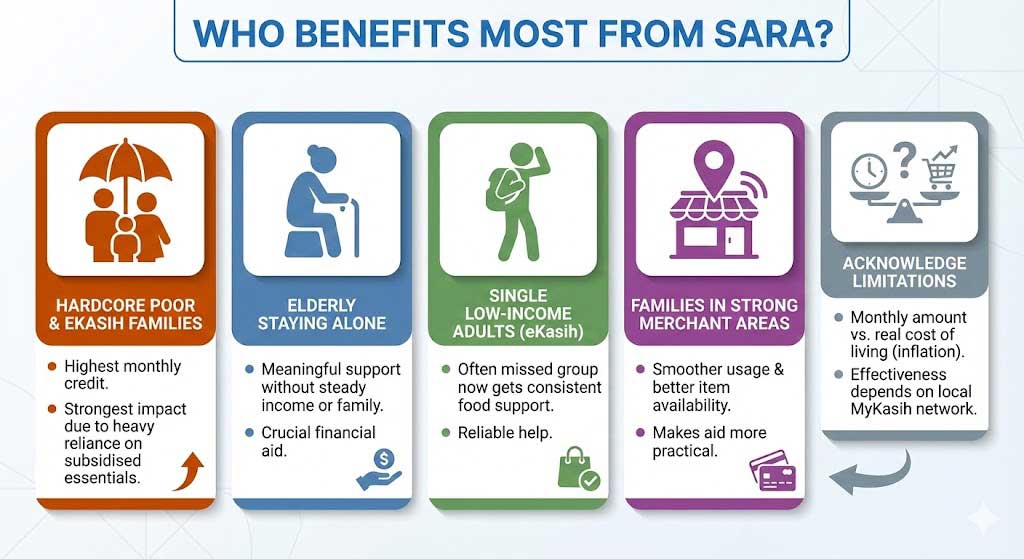
While SARA is often described as bantuan for “B40,” the groups that benefit most are far more specific. The hardcore poor and eKasih-registered families feel the strongest impact because they receive the highest monthly credit and rely heavily on subsidised essentials. Elderly individuals living alone also gain meaningful support, especially when they lack steady income or family assistance. Single low-income adults in eKasih—a group often missed by other aid programmes—finally receive consistent food support through SARA. Households in areas with strong MyKasih merchant coverage experience smoother usage and better item availability, making the aid more practical. Still, it’s important to recognise limitations: monthly allocations may not fully match rising living costs, and effectiveness depends heavily on how well each region is served by the MyKasih retail network.
Common Confusions & Misconceptions About SARA
- “Adakah SARA untuk semua rakyat Malaysia?”
Tidak. SARA adalah bantuan tersasar, bukan universal. Hanya penerima STR 2025 yang layak, dan jumlah bergantung kepada status eKasih serta kategori isi rumah. - “Perlu daftar SARA ke?”
Tidak – SARA aktif secara automatik bila STR anda Lulus. - “Perlu daftar eKasih ke?”
Tidak wajib, tetapi eKasih memberi akses ke tier SARA yang lebih tinggi. Jika tidak tersenarai, anda hanya menerima kadar standard. - “Kenapa jiran saya dapat RM200 tapi saya cuma RM100?”
Perbezaannya datang daripada status eKasih. eKasih = kadar tinggi; STR sahaja = kadar standard.
Risks, Gaps & What to Watch for in 2026
SARA offers meaningful short-term relief, but it is not a long-term solution to structural poverty; its impact depends heavily on accurate income data and whether families keep their STR and eKasih information updated. Households that fail to update changes in dependents, income, or address risk being placed in the wrong tier or missing SARA entirely. For 2026, details will depend on the official Federal Budget and MOF circulars—so no assumptions should be made until guidelines are released. For a full view of next year’s bantuan landscape, including any updates to STR categories and add-on programmes, see our upcoming STR Ecosystem 2026 guide.
SARA FAQ
What is Sumbangan Asas Rahmah (SARA)?
SARA is a monthly essential-goods assistance programme credited directly into your MyKad. It can be used to purchase approved items at participating MyKasih merchants. It functions as an additional layer of support on top of the Sumbangan Tunai Rahmah (STR) cash aid.
Who is eligible for SARA 2025?
Only approved STR 2025 recipients in specific categories are eligible for SARA. Households listed under eKasih receive the highest tier, while non-eKasih STR recipients receive the standard tier.
How do I check my SARA status?
You can check your SARA eligibility and activation through the official MyKasih portal at checkstatus.mykasih.net, using your MyKad number.
How much does SARA provide for eKasih recipients vs standard STR recipients?
Refer to the SARA amount table above for the full breakdown.
What can SARA be used to buy?
SARA can only be used to purchase essential items such as rice, cooking oil, eggs, chicken, vegetables, bread, basic canned food, and certain infant products. The exact selection depends on each MyKasih merchant.
If I don’t use my SARA balance this month, can it carry forward to the next month?
No. SARA credit does not roll over. Any unused balance will expire at the end of the month.
