

Introduction
Stamp duty in Malaysia is a tax imposed on legal documents, particularly those related to property transactions, tenancy agreements, and financial instruments. Whether you are buying a house, signing a rental agreement, or taking a loan, stamp duty is a mandatory cost you cannot ignore. If you are planning a purchase, this guide to buying your first home in Malaysia also explains other important costs involved in the process. To explore the latest affordable housing schemes, eligibility requirements, and application guides, read our complete guide on Affordable Housing Programmes in Malaysia.
Many Malaysians end up overpaying or facing penalties simply because they do not fully understand how stamp duty works. Governed under the Stamp Act 1949, this tax plays a crucial role in ensuring that legal documents are valid and enforceable.
In this guide, you will learn everything you need to know about stamp duty Malaysia, including applicable rates, how to calculate it, examples for property and tenancy, and common mistakes to avoid.
What Is Stamp Duty in Malaysia?
Stamp duty in Malaysia refers to a tax charged on legal documents (also known as instruments). These documents must be stamped by the Inland Revenue Board of Malaysia (LHDN) to be legally recognised.
There are two main types of stamp duty:
- Ad valorem duty: Based on the value of the transaction or asset (commonly used for property transfers)
- Fixed duty: A flat fee charged regardless of value (used for documents like statutory declarations)
Stamp duty is governed by the Stamp Act 1949, specifically under the First Schedule, which outlines the rates for different types of documents.
Why Stamp Duty Matters in Malaysia
Stamp duty is not just an administrative requirement—it has legal implications.
A stamped document is generally required for:
- Legal enforceability
- Use in court as evidence
- Official recognition of agreements
If a document is not stamped:
- It may not be admissible in court
- You may face delays in legal processes
- Penalties may be imposed
30-Day Rule
In Malaysia, documents must typically be stamped within 30 days from the date of execution. Late stamping may result in penalties, which increase the longer the delay.
Because of this, understanding stamp duty early can help you avoid unnecessary costs and complications.
What Documents Are Subject to Stamp Duty?
Stamp duty applies to a wide range of legal documents in Malaysia.
Property Transfer Documents
- Memorandum of Transfer (MOT)
- Sale and purchase-related instruments
Loan and Financing Agreements
- Housing loan agreements
- Financing contracts with banks or institutions
Tenancy and Lease Agreements
- Residential rental agreements
- Commercial lease contracts
Other Legal Documents
- Statutory declarations
- Power of attorney
- Company incorporation documents
Understanding which documents are subject to stamp duty helps you prepare for the costs involved in different transactions.
Stamp Duty for Property Transfer (MOT) in Malaysia
Property transfer stamp duty (also known as MOT stamp duty) is one of the largest costs in property purchases.
Stamp Duty Rates for Malaysian Buyers
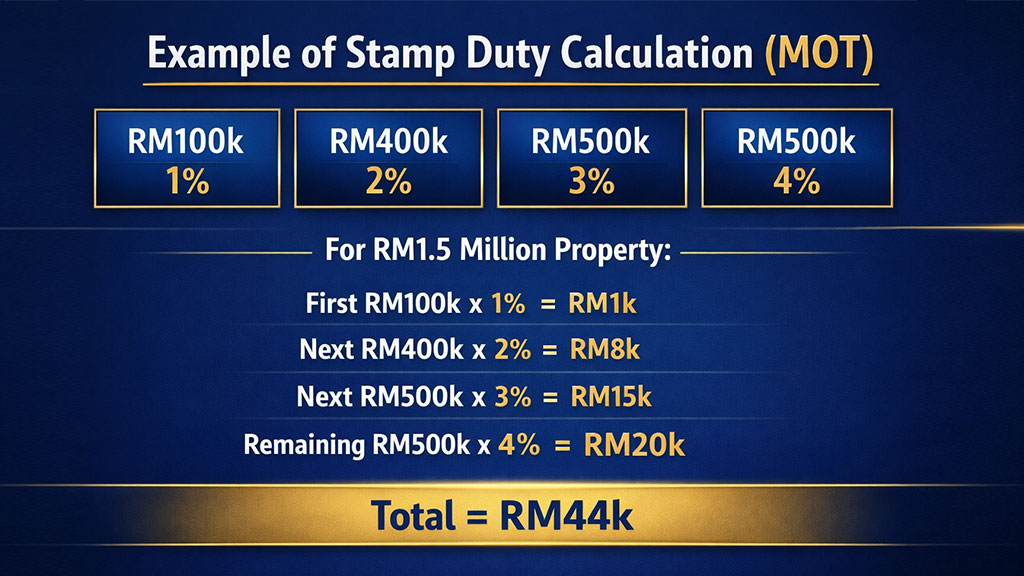
Stamp duty is calculated progressively based on property value:
| Property Value | Rate |
| First RM100,000 | 1% |
| Next RM400,000 | 2% |
| Next RM500,000 | 3% |
| Above RM1,000,000 | 4% |
How Stamp Duty Calculation Works
Stamp duty in Malaysia uses a tiered (progressive) system, meaning each portion of the property price is taxed at a different rate.
It is important to note that the entire property price is not taxed at one single rate.
Example of Stamp Duty Calculation (RM1.5 Million Property)
Let’s break down a RM1,500,000 property:
- First RM100,000 × 1% = RM1,000
- Next RM400,000 × 2% = RM8,000
- Next RM500,000 × 3% = RM15,000
- Remaining RM500,000 × 4% = RM20,000
Total Stamp Duty = RM44,000
This step-by-step approach ensures accurate calculation and helps avoid overpayment.
Stamp Duty for Foreign Buyers (2026)
Foreign buyers in Malaysia are subject to different stamp duty considerations depending on the property type:
- Residential property: Typically higher rates or thresholds may apply
- Commercial property: Often follows standard rate structures
Because policies can change, foreign buyers should always verify the latest rules before purchasing property.
Stamp Duty on Loan Agreements in Malaysia
Stamp duty is also applicable when you take a loan, such as a housing loan.
Standard Rate
- 0.5% of the total loan amount
This is separate from property transfer stamp duty and must be calculated independently.
Example Calculation
If your housing loan is RM500,000:
- RM500,000 × 0.5% = RM2,500
This amount is payable when executing the loan agreement.
Stamp Duty for Tenancy Agreements in Malaysia
Stamp duty also applies to tenancy agreements and is commonly overlooked.
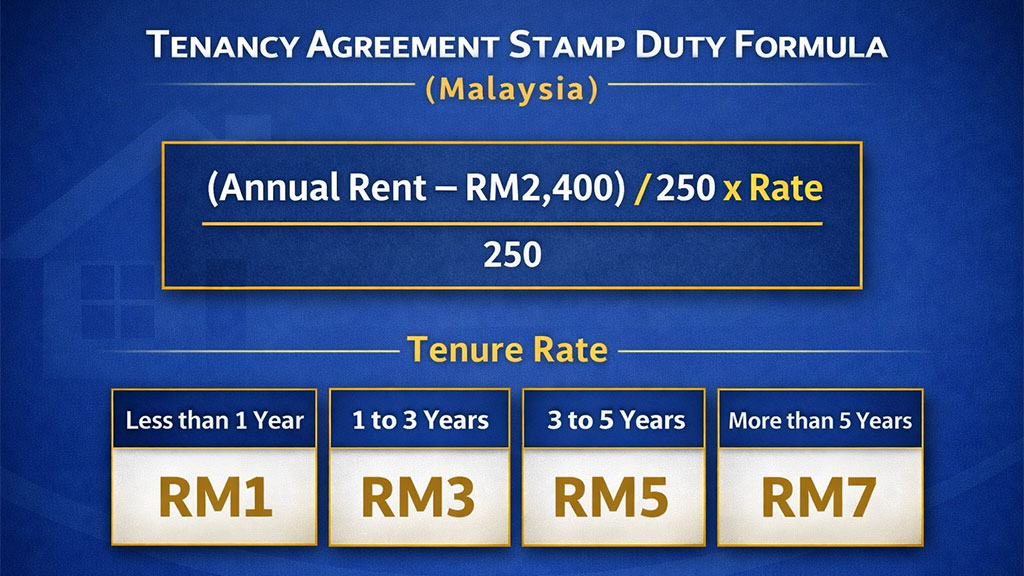
Stamp Duty Rates by Tenure
| Tenure | Rate |
|---|---|
| Less than 1 year | RM1 |
| 1–3 years | RM3 |
| 3–5 years | RM5 |
| More than 5 years | RM7 |
How to Calculate Tenancy Stamp Duty
Stamp duty for tenancy agreements is based on annual rental value.
Formula:
(Monthly Rent × 12) ÷ 250 = Chargeable units
Then multiply by the applicable rate
Example Calculation
For a monthly rent of RM3,000:
- Annual rent = RM3,000 × 12 = RM36,000
- RM36,000 ÷ 250 = 144 units
- 144 × RM3 = RM432
Total Stamp Duty = RM432
Who Pays Stamp Duty?
In Malaysia, tenancy stamp duty is typically:
- Shared between landlord and tenant, or
- Paid by the tenant (common practice)
However, this depends on the agreement terms between both parties.
Other Common Stamp Duty Charges in Malaysia
Some documents are subject to fixed stamp duty:
| Document | Stamp Duty |
|---|---|
| Statutory Declaration | RM10 |
| Power of Attorney | RM10 |
| Memorandum of Association | RM100 |
These are generally straightforward and do not require complex calculations.
Common Mistakes to Avoid When Paying Stamp Duty
Understanding stamp duty can help you avoid costly errors.
Missing the 30-Day Deadline
Late stamping results in penalties that increase over time.
Using the Wrong Property Value
Stamp duty may be based on the higher of:
- Sale price (SPA), or
- Market valuation
Not Stamping Tenancy Agreements
Many landlords and tenants skip this step, which can cause legal issues later.
Confusing Different Stamp Duties
Property transfer, loan agreements, and tenancy agreements all have different rules.
Ignoring Foreign Buyer Rules
Foreign buyers may face different rates or restrictions, which should not be overlooked.
FAQs About Stamp Duty Malaysia
What happens if stamp duty is not paid?
The document may not be legally enforceable and cannot be used in court. Penalties may also apply.
Who pays stamp duty in Malaysia?
It depends on the agreement. For property purchases, the buyer usually pays. For tenancy, it may be shared or paid by the tenant.
Is stamp duty compulsory for tenancy agreements?
Yes. While some may skip it, stamping ensures the agreement is legally valid.
Can stamp duty be refunded?
In certain cases, such as cancelled transactions, a refund may be possible subject to approval.
How is stamp duty calculated for property?
It is calculated using a progressive rate system based on property value.
Is stamp duty different for foreigners?
Yes, foreign buyers may be subject to different policies or thresholds depending on property type and regulations.
Conclusion
Stamp duty in Malaysia is a mandatory cost that applies to many legal documents, especially in property transactions, loans, and tenancy agreements. Despite being a standard requirement, it is often misunderstood, leading to overpayment or penalties.
By understanding how stamp duty Malaysia works—including rates, calculation methods, and applicable documents—you can make better financial decisions and avoid unnecessary complications.
Apart from stamp duty, other taxes like real property gains tax (RPGT) may also apply when you sell your property. Understanding both can help you plan your finances better. You can read this real property gains tax Malaysia guide for a detailed explanation.
