
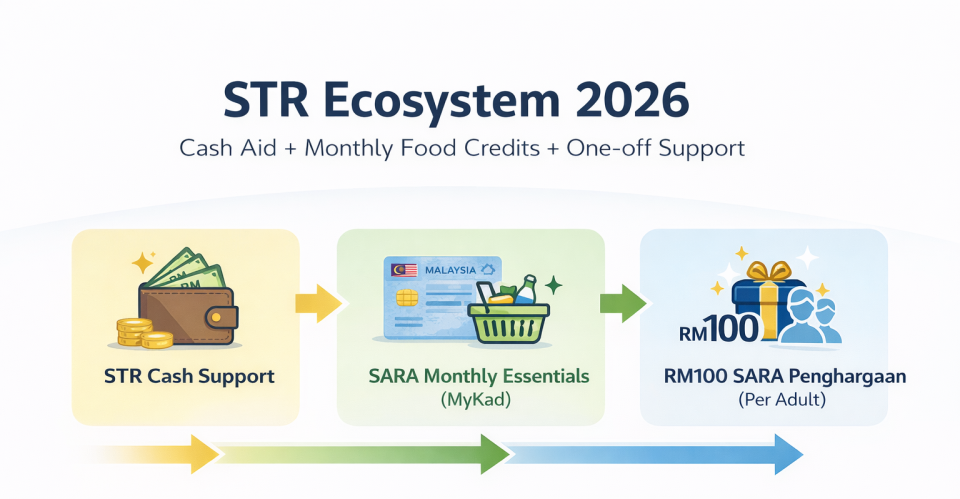
From 2026 onwards, Sumbangan Tunai Rahmah (STR) is no longer “just cash in the bank”. Under Budget 2026, the government has turned STR into a full support ecosystem that combines annual cash payments, monthly Sumbangan Asas Rahmah (SARA) credit via MyKad, and a one-off SARA Penghargaan RM100 for all adults.
In total, the government has increased the combined STR + SARA allocation to RM15 billion in 2026 (up from RM13 billion in 2025), benefiting around nine million STR recipients, with SARA Penghargaan reaching about 22 million adults.
This article walks through everything that sits under the STR ecosystem in 2026—who qualifies, exact cash amounts, how SARA fits in, and how much support a household can realistically expect across the year.
Disclaimer: This guide summarises official information from Budget 2026 announcements, LHDN STR documentation and MOF / SARA portals. For the latest updates, always refer to bantuantunai.gov.my (MySTR) and sara.gov.my.
STR 2026 & SARA 2026 at a Glance (Overview)
Before we go into detail, here’s what the ecosystem looks like in 2026. The government has allocated RM15 billion combined for STR and SARA, covering approximately nine million STR recipients who receive both cash and monthly SARA credit. About one million of these recipients are registered in the eKasih system and qualify for the highest SARA tier. Beyond STR recipients, 22 million Malaysian adults aged 18 and above will receive a one-off SARA Penghargaan of RM100 in February 2026, regardless of their STR status.
The ecosystem has three main components. STR 2026 provides annual cash payments for eligible households and elderly recipients. SARA 2026 adds monthly credit via MyKad that can be used at MyKasih merchants for essential items. SARA Penghargaan 2026 gives every adult Malaysian a one-time RM100 credit, timed around Ramadan and Chinese New Year preparations.
For STR cash in 2026, households in the B40 category (monthly income ≤ RM2,500) receive between RM700 and RM2,200 per year depending on the number of children. M40 households (income RM2,501 to RM5,000) get between RM200 and RM950 annually. Elderly recipients without a spouse receive RM600 per year. Single individuals (Bujang) no longer receive STR cash—their support comes entirely through SARA.
For SARA monthly credit in 2026, STR recipients who are also registered in eKasih receive RM200 per month, totaling RM2,400 for the year. Other STR households and elderly recipients get RM100 per month (RM1,200 annually), while STR-approved Bujang receive RM50 per month (RM600 yearly).
How the STR Ecosystem Works in 2026
STR is the Cash Backbone
Sumbangan Tunai Rahmah (STR) remains the core cash assistance in 2026. Eligible households and elderly recipients receive cash credited directly into their bank account, or can withdraw it over the counter at BSN if they don’t have a valid account.
The amount depends on your income band (B40 earning ≤ RM2,500 versus M40 earning RM2,501 to RM5,000), the number of children in your household, and your category (household versus elderly). We’ll show the full breakdown in the table further down.
SARA is the Monthly Essentials Layer on Top of STR
Starting 2026, all STR recipients—around nine million people—will also receive Sumbangan Asas Rahmah (SARA) as a monthly MyKad credit for essential groceries at registered MyKasih merchants.
Two levels exist. Standard SARA provides RM100 per month for households and elderly recipients, or RM50 per month for Bujang. Higher SARA, available to those registered as miskin or miskin tegar in eKasih, provides RM200 per month.
The SARA 2026 credit is loaded monthly into your MyKad and used cashlessly at MyKasih supermarkets and kedai runcit. It’s restricted to 14 categories of essential items such as rice, cooking oil, eggs, chicken, vegetables, bread, basic canned goods, and hygiene necessities.
SARA Penghargaan: RM100 for All Adults
On top of STR and monthly SARA, the government will again give RM100 “Penghargaan SARA” to all Malaysians aged 18 and above, regardless of whether they receive STR. This one-off payment is scheduled for mid-February 2026, timed to help with Ramadan and Chinese New Year preparations. Approximately 22 million MyKad holders will receive this payment.
In other words, every adult gets at least RM100 via SARA, while STR recipients get much more through the full ecosystem.
Who Is Eligible for STR 2026? (Syarat Kelayakan STR 2026)
You need to be approved for STR 2026 before you can receive STR cash and the monthly SARA 2026 that comes with it. Eligibility uses three main categories: Household (Isi Rumah), Elderly (Warga Emas Tiada Pasangan), and Bujang.
Household (Isi Rumah)
To qualify as a household, you must be a Malaysian citizen who is either married (with or without children) or a single parent or guardian with at least one child who meets the conditions. Your monthly household income must be RM2,500 or below for the B40 band, or between RM2,501 and RM5,000 for the M40 band. Children included for STR must meet age, study, or dependency rules as defined by LHDN.
Elderly (Warga Emas Tiada Pasangan)
To qualify as an elderly recipient, you must be a Malaysian citizen aged 60 and above with no spouse and no child who meets STR conditions. Your monthly income must be RM5,000 or below. These recipients get STR as individual seniors plus access to SARA.
Bujang (Single Individuals)
This is where 2026 changes are most visible. To qualify as Bujang, you must be a Malaysian citizen aged 21 to 59 (or 19 and above if you’re registered as OKU with JKM). You must have never married, or be widowed or divorced with no eligible child. You cannot be a full-time student at a public or private institution, and your monthly income must be RM2,500 or below.Important change for 2026: Bujang who qualify for STR do not receive STR cash in 2026. Instead, they receive SARA 2026 monthly credit of RM50 per month. So they still need to apply for STR, but the benefit arrives as SARA, not STR cash.
How to Apply for STR 2026 Online (MySTR) & Key Dates
Applications open all year starting 13 October 2025 under a “permohonan sepanjang tahun” (year-round application) system. However, to be included in Phase 1 payments, applicants are advised to submit or update their details by 28 November 2025.
Applications and updates are done through the MySTR portal at bantuantunai.gov.my. For those without digital access, manual forms can be submitted at LHDN branches, but MySTR is now the main gateway. Also check out Bright Side of News for the Sumbangan Tunai Rahmah Application guide, the application process is more or less the same every year.
STR 2026 Cash Amounts (By Category)
The table below shows the annual STR cash amounts for 2026, as summarised from Budget 2026 and STR-focused portals that mirror official figures.
STR 2026 — Annual Cash Amounts
| Category | Income Band | Children | STR 2026 Cash (Year) |
| Household (Isi Rumah) | ≤ RM2,500 | 0 | RM700 |
| 1-2 | RM1,200 | ||
| 3-4 | RM1,700 | ||
| ≥5 | RM2,200 | ||
| Household (Isi Rumah) | RM2,501-RM5,000 | 0 | RM200 |
| 1-2 | RM450 | ||
| 3-4 | RM700 | ||
| ≥5 | RM950 | ||
| Elderly (Warga Emas Tiada Pasangan) | ≤ RM5,000 | — | RM600 |
| Bujang | ≤ RM2,500 | — | RM0 (no STR cash) |
Sources consistently show this structure, with B40 and M40 households getting different tiers depending on children, and elderly singles receiving RM600. Note that for Bujang, the RM600 STR seen in earlier years is removed in 2026 and replaced by SARA credit instead.
SARA 2026: Monthly Support Inside the STR Ecosystem
In 2026, SARA becomes a standard add-on for STR—not just a special scheme for the poorest.
Who Gets SARA 2026?
There are three main SARA streams. First, STR recipients registered in eKasih (miskin or miskin tegar) receive RM200 per month, totaling RM2,400 per year. Second, other STR recipients not in eKasih get RM100 per month for households and elderly (RM1,200 annually), or RM50 per month for Bujang (RM600 annually). Third, all Malaysians aged 18 and above, regardless of STR status, receive the one-off SARA Penghargaan of RM100 in February 2026.
How SARA 2026 Works in Practice
SARA credit is loaded to MyKad every month for 12 months (January to December 2026) for eligible STR recipients. You can spend it only at participating MyKasih or SARA merchants such as supermarkets, mini markets, and selected kedai runcit. It is restricted to 14 essential categories including rice, cooking oil, sugar, flour, eggs, chicken, fish, fresh vegetables, fruit, bread, baby items, and basic hygiene and cleaning products.
There is no separate SARA application form. Eligibility is derived automatically from your STR 2026 status (showing as “Lulus”) and your eKasih status for the higher RM200 per month tier.
How Much Can a Household Get from STR Ecosystem in 2026?
Example 1: B40 Household, 5 Children, in eKasih (Maximum Tier)
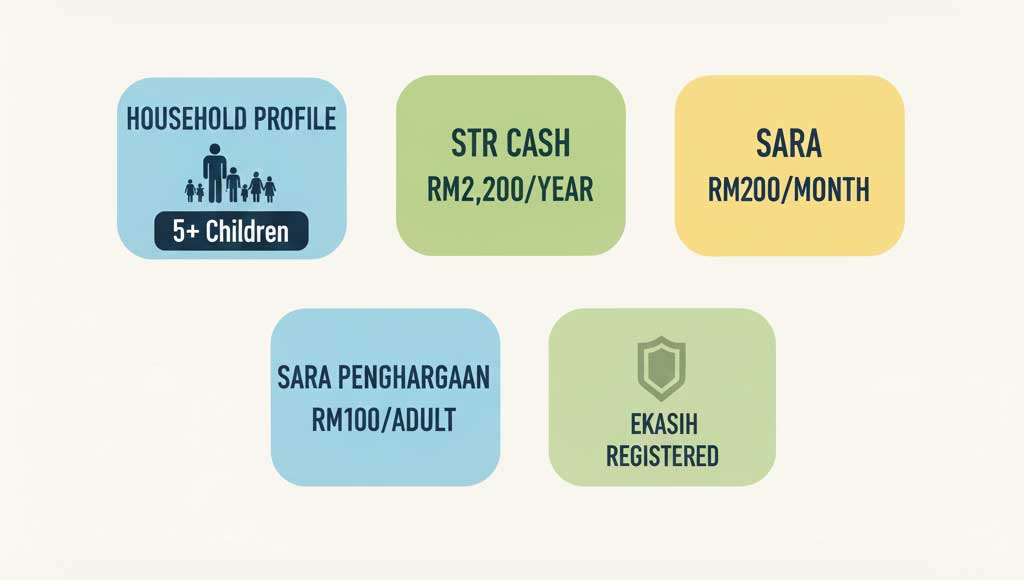
Consider a household with monthly income of RM2,500 or below, with five or more children, and registered in eKasih. This household receives STR 2026 cash of RM2,200 per year plus SARA 2026 at RM200 per month (RM2,400 per year). Additionally, each adult in the household gets the SARA Penghargaan of RM100.
The total potential support for the primary STR household is approximately RM4,600 per year (excluding multiple adults’ SARA Penghargaan amounts).
Example 2: M40 Household, RM4,000 Income, 2 Children (Not in eKasih)
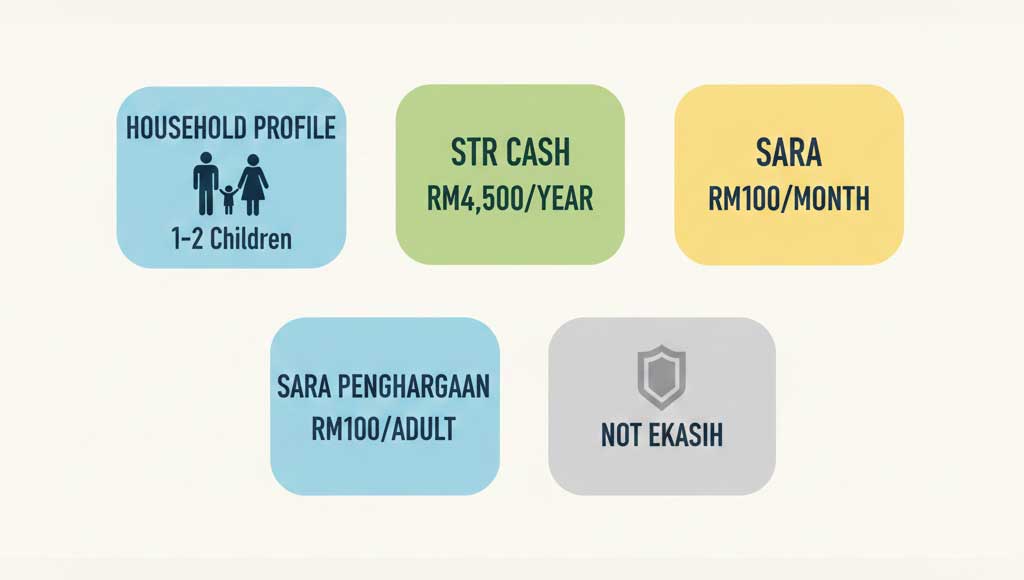
This household falls in the RM2,501 to RM5,000 income band with one to two children and is not registered in eKasih. They receive STR 2026 cash of RM450 per year plus SARA 2026 at RM100 per month (RM1,200 per year).
The total comes to approximately RM1,650 per year, plus SARA Penghargaan RM100 per adult in the household.
Example 3: Elderly Person Living Alone (Not in eKasih)
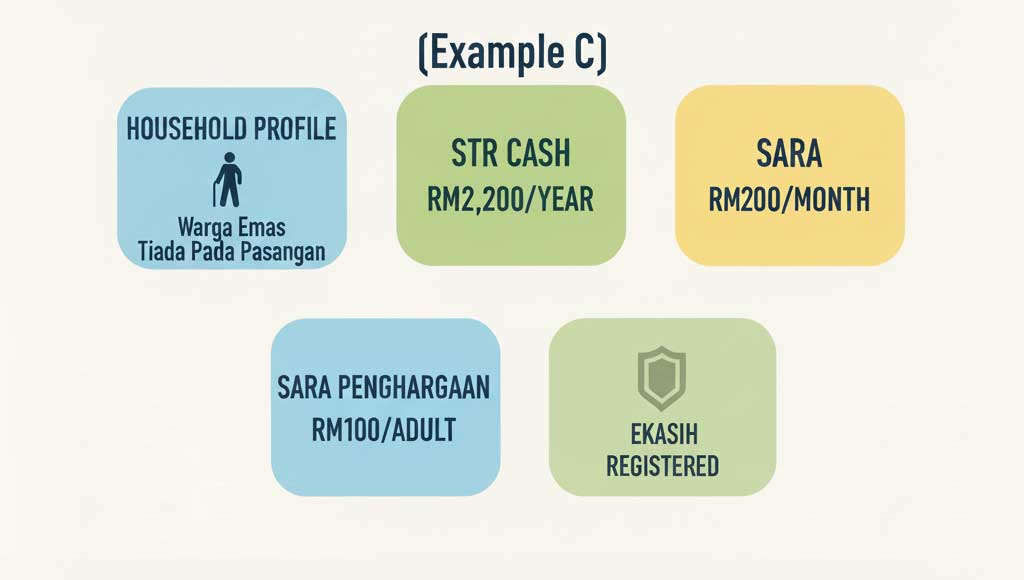
An elderly person without a spouse, with income of RM5,000 or below, receives STR 2026 cash of RM600 per year. They also get SARA 2026, and common guides summarise elderly as RM100 per month for standard STR recipients (RM1,200 per year).
The total is approximately RM1,800 per year plus SARA Penghargaan of RM100.
Example 4: Bujang, Income RM2,000, Not in eKasih
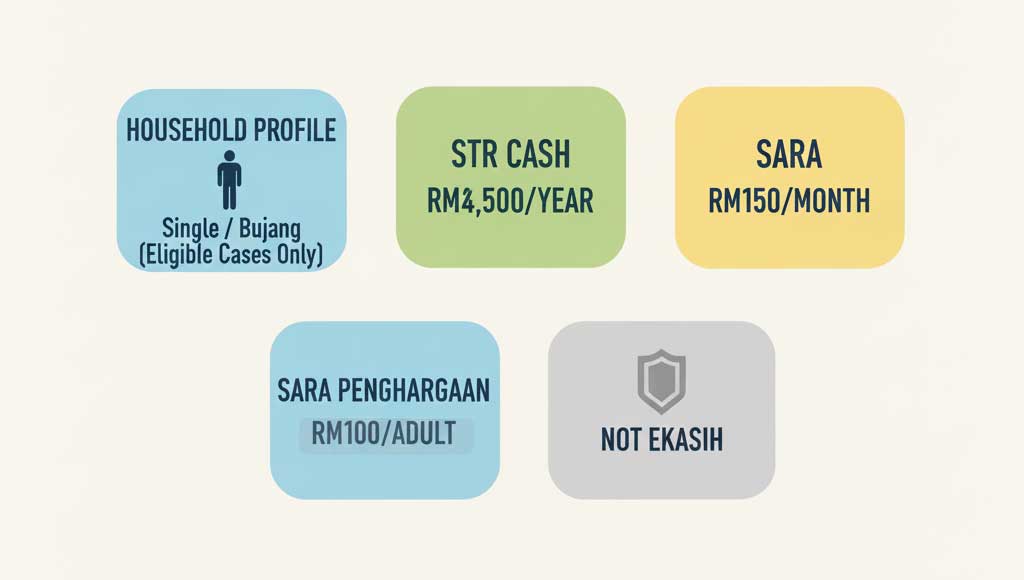
A single person aged 21 to 59 with monthly income of RM2,500 or below receives no STR 2026 cash. However, they get SARA 2026 at RM50 per month (RM600 per year) plus SARA Penghargaan of RM100.
The total is RM700 per year, fully as credit via MyKad.
These examples show the logic of the 2026 redesign. STR cash is slightly reduced for households (by RM300) but SARA is increased by RM300, keeping overall support stable or higher. Bujang are pushed from cash into in-kind monthly support through SARA.
How to Apply, Update & Check STR 2026
Applying or Updating STR 2026
You must apply or update STR to be in the ecosystem. Start by going to the MySTR portal at bantuantunai.gov.my. Choose “Permohonan Baharu” (new application) if you’re applying for the first time, or log in to update your existing details.
Fill in the required personal details including income, marital status, bank account information, and dependants. Submit your application and wait for your status to show as “Lulus” (approved), “Tidak Lulus” (not approved), or “Dalam Proses” (in process) in the portal.
For those without internet access, manual forms can be submitted at selected LHDN branches and appointed counters, but MySTR is now the main gateway.
“Permohonan Sepanjang Tahun” — What It Really Means
Applications open throughout the year from 13 October 2025. However, to be included in early phases of 2026 payment, you should apply or update before specific cut-off dates. For example, the deadline for Phase 1 is 28 November 2025.
If your application is approved later, payments (including SARA) start from the phase your STR is approved. There is no backpay for earlier months, so applying early is important.
Checking STR & SARA Status
Check your STR status via MySTR at bantuantunai.gov.my. Check your SARA status and SARA Penghargaan via sara.gov.my or the MyKasih/SARA status portal when it goes live.
STR 2026 vs STR 2025: What Changed for Cash & SARA?
A quick comparison helps readers who already received STR or SARA in 2025 understand what’s different.
The total budget allocation has increased from RM13 billion in 2025 to RM15 billion in 2026 for the combined STR and SARA programs. The biggest change affects Bujang, who previously received RM600 STR cash annually but now receive only RM50 per month SARA (RM600 per year) via MyKad instead.
For households, STR cash has been reduced by RM300 across all categories, but SARA has been increased by RM300, making total support similar or slightly higher. The key shift is that all STR recipients now get SARA as standard. In 2025, SARA was focused more heavily on eKasih and specific STR segments, but in 2026, all STR recipients receive SARA (either RM100 or RM50 per month), with eKasih registered households getting the highest tier of RM200 per month.
SARA Penghargaan continues for all adults in 2026. The RM100 one-off payment is repeated, covering approximately 22 million adults and credited around February 2026.
Overall, the direction is clear: less pure cash, more structured support locked to essentials.
Risks, Gaps & What to Watch in 2026
Even though STR + SARA 2026 is generous on paper, there are real-world gaps to watch.
Data accuracy matters significantly. If STR or eKasih records are outdated—due to income changes, new dependants, or address changes—households may be placed in the wrong tier or miss SARA entirely. It’s crucial to keep your information updated through MySTR.
Merchant coverage and item availability will affect the actual impact of SARA. The value of your SARA credit depends on how many MyKasih or SARA merchants operate in your area and how well-stocked they are with essential items. Rural areas may have fewer participating merchants.
The behaviour shift from cash to in-kind support is a significant change. With more value moved into SARA, households have less flexible cash but more guaranteed access to basics. This works well for food security, but may feel restrictive for other urgent needs like medical expenses or emergency repairs.
Finally, watch for policy tweaks mid-year. Any adjustment to subsidy targeting or STR schedule might affect payment phases, amounts, or implementation details. Keeping an eye on official MOF and LHDN announcements is essential.
FAQ
Is STR still available in 2026?
Yes. STR 2026 continues with adjusted cash amounts and integrated SARA support. The program has evolved into a full ecosystem rather than being discontinued.
Does every STR 2026 recipient get SARA 2026?
Yes. All approved STR recipients receive SARA 2026. Those registered in eKasih get the highest tier of RM200 per month, while others get RM100 per month (households and elderly) or RM50 per month (Bujang).
Do Bujang still get STR cash?
No. Bujang no longer receive STR cash in 2026. Instead, they receive SARA credit of RM50 per month (RM600 per year) via their MyKad.
Can I get SARA without STR?
For monthly SARA, you must be approved for STR 2026 (showing “Lulus” status). The only exception is SARA Penghargaan of RM100, which is given to all Malaysians aged 18 and above regardless of STR status.
When does SARA 2026 start?
SARA monthly credit runs from January to December 2026 for approved STR recipients. SARA Penghargaan is credited as a one-off payment around mid-February 2026.
Where can I check my STR and SARA status?
Check your STR status at bantuantunai.gov.my (MySTR portal). Check your SARA and SARA Penghargaan status at sara.gov.my or through the SARA/MyKasih status checker when it’s announced.
